
Umbra · Universal Launch Platform
Drone launchers for counter‑UAS and strike
One drone launch node, any host.
The UAV launcher configured for your effector — integrate it onto almost any platform, ground, surface or subsea, and launch where GNSS and jamming have taken everything else down. Counter-UAS and strike, from one core.
Launchers
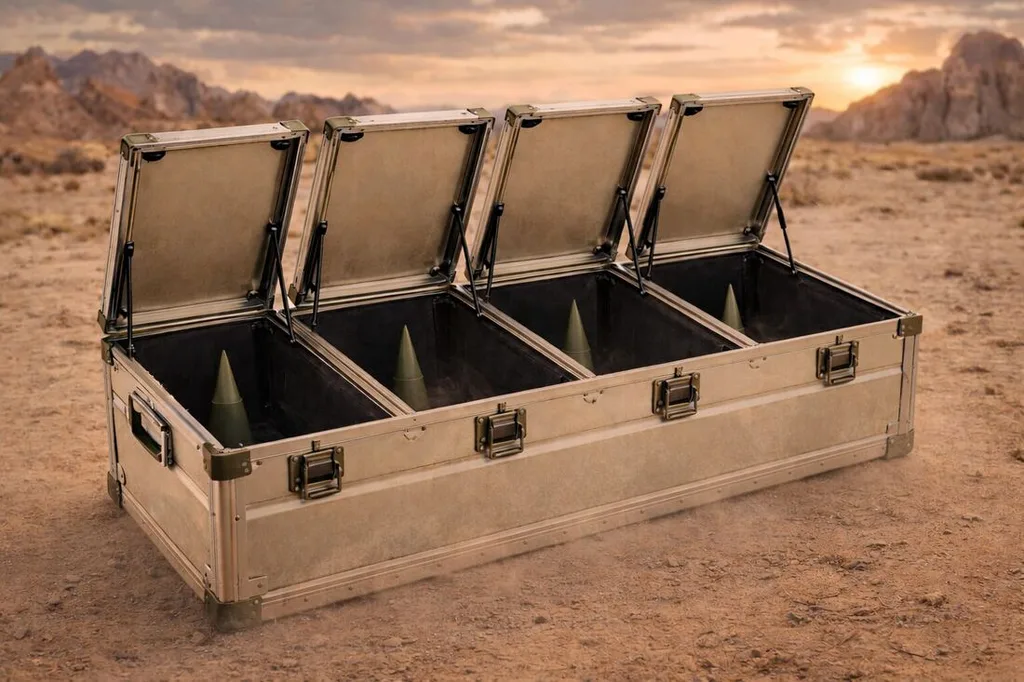
Drone launchers on one smart core
The Silentis launcher core runs Umbra in two mission builds — Counter-UAS and Strike — and Umbra Box, a drone in a box for a single large UAS. The Umbra Launch Tube, a single launch cell sized to your effector and fired by an Umbra node or your own launch system, is the entry point to the range. Each stays host- and effector-agnostic as the range expands, and each has Silentis drones matched to it.
Counter-UAS launcher
Umbra Counter-UAS
Turn any host into a counter-drone shooter — cued by any sensor or C2, flying a cheap drone interceptor onto the track, GNSS-independent and under jamming.
Explore Counter-UAS →Loitering-munition launcher
Umbra Strike
Any host becomes a strike node — a dense magazine of loitering munitions fired in salvo across ground, surface and subsea.
Explore Strike →Single-cell launcher
Umbra Launch Tube
A single launch cell configured for your effector, for Counter-UAS and Strike — the entry point to the range.
Explore Launch Tube →Drone in a box
Umbra Box
A docking station custom-sized to a single large UAS — cued by your own detection system, operator-in-the-loop or autonomous, with recovery available by configuration.
Explore Umbra Box →Silentis drones, matched to each launcher: Interceptor UAS · FPV Strike UAS · LR Strike UAS →
How it works
The Launcher Core — one core, every host
Silentis Umbra is the launch node that bolts onto a host already in service and fires tube-launched drones in salvo, with catapult launcher and pneumatic launcher options where an effector needs a boosted launch.
Launches without GNSS, under jamming
No satellite fix required, and the node runs its own arm–safe–fire sequence when the radio link is contested — accurate launch under active jamming and spoofing.
Open everywhere but the core
Open-source Linux and open, documented interfaces around one proprietary smart core — MOSA-aligned, built to the Modular Open Systems Approach.
Cues from the sensors you already run
Track cue-in over ASTERIX, Cursor-on-Target and the SAPIENT sensor-fusion ICD, plus STANAG 4586‑compatible node tasking and track-reporting, a design target with no certification held (see standards).
Any host, your effector
Host- and effector-agnostic — link the effector, hand it off, and let go, netting air, surface and subsea nodes into one layered network.
Fibre- or radio-linked control
The node carries the effector's own link — fibre or radio, straight from the launch point — one node to field and protect.
See the technology → · Standards →
One core · Every host
The same core fits the host you already run


In the field today
Launched drones are already deciding battles
Silentis Umbra answers a pattern repeating in conflict after conflict: cheap, host-launched drones are already deciding engagements, and the kinetic drone is the answer that scales.
Boat-launched FPVs killed two Pantsir-S1 and an Osa — air defence destroyed from the deck of an unmanned boat.
Interceptor drones destroyed more than 33,000 attacking UAVs in a single month — the kinetic answer, at scale.
Some 90 were jam-immune fibre-optic FPVs — and an advanced military still has no fielded answer.
Built for integrators
You own the customer — Umbra is the node inside your solution
Silentis Umbra drops into the C2 and sensors an integrator already runs — cued in from any sensor, best-effector, over open, documented interfaces, in line with MOSA and EU interchangeability rules — so you own the customer and the solution while Umbra runs as the launch node inside it.
Startups
Put a working launch node behind your effector or system and demo it now — real hardware in the field.
Distributors
The launch capability your government customers want — bring it to your network while Silentis runs the technical and operational support behind you.
Integrators
Fold it in as an open, MOSA-aligned launch subsystem — host- and effector-agnostic, low integration effort, and it plugs into the C2 you already run.
The value split
Durable node, consumable effector
Silentis Umbra splits the system in two: the launch node is durable capital you keep, and the effector is a consumable you buy and resupply on the open market.
Node
Durable capital that outlives many munition cycles — kept open and effector-agnostic so it keeps working as the effector market moves.
Effector
Consumable, re-bought each engagement on the open market — magazine depth as attritable mass, holding cost-per-engagement below the cost of what it defeats.
Briefing
Request a briefing on Umbra
Capability, interfaces and integration detail are shared with qualified partners in a briefing.
Request a briefing